Cambridge City Lacrosse: How Two Strangers Built One of the UK’s Most Welcoming Clubs

When Cambridge City Lacrosse began, it wasn’t a grand plan, a funded initiative, or even a long-held ambition. It was simply two women — both new to the city, both emerging from lockdown, both missing sport and community — meeting for the first time in a park with lacrosse sticks and the vague idea that maybe somebody else might want to play too.
That unlikely beginning has since become one of the fastest-growing, most socially vibrant mixed lacrosse clubs in the UK.

The story started in 2019, when Rad, the club’s co-founder moved to Cambridge after university, assuming, as most players would, that a city like Cambridge would naturally have a club side. It didn’t. The nearest options were an hour’s drive away and attempts to join the university team led nowhere. It wasn’t until March 2021 — after months of lockdown and an abandoned search for local opportunities — that Brucie Morris from SEWLA connected her with Milly, a newcomer who’d also asked about forming a club.

“Do you want to be friends?” her first email essentially said. And that was enough. The pair met, bonded instantly, and began casually throwing a ball around on the local common. Soon after, they created a Facebook page and invited the community to join them. A few colleagues turned up, then a few players with forgotten sticks in the back of wardrobes, and then Henry — a newly appointed chicken vet — whose arrival sparked the now-iconic club mascot: the chicken.
Cambridge City Lacrosse suddenly had personality.
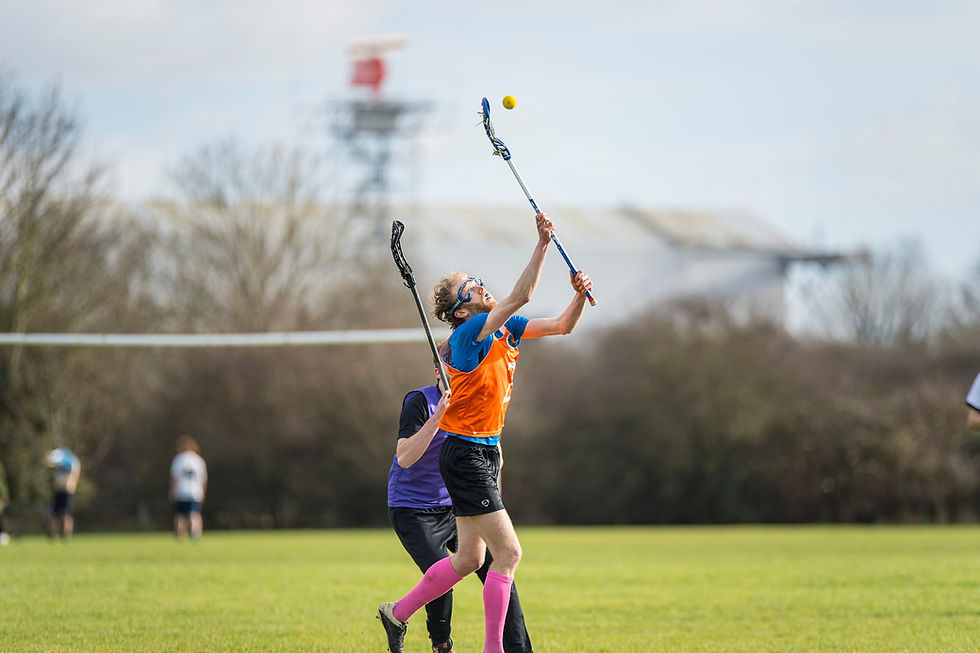
What it didn’t have, at first, was success. After initially playing friendlies against teams like Panthers and Rainbow Rexes, when they finally entered the East Mixed League in the 2022-2023 season, they suffered some crushing losses. Scores of 22–0 and 24–1 were not anomalies; they were the norm. And yet, strangely, this was the making of the club.
“Once you’ve lost 24–1, nobody throws a strop,” Rad laughs. “If you score even one goal, the celebration is unbelievable.” That season of heavy defeats created something that can’t be trained or coached: a culture where camaraderie mattered more than results, where effort outweighed outcome, and where belonging was the primary goal.

The club was on the map and attracting more and more players.

Those foundations paid off. By the 2023–24 season, the club had grown to more than 70 members, drawing in both beginners and experienced players. With greater depth, confidence, and cohesion, Cambridge City vaulted up the league table, finishing third nationally.


The following year, they reached the national final — losing to Oxford City by just one goal in the closing seconds. The same two women who had once been alone in a field cried together on the sidelines, overwhelmed by how far the club had come.
And yet, despite the competitive rise, the ethos hasn’t shifted. This is a club where water-balloon drills, three-legged lacrosse, and “laxcation” holidays sit comfortably alongside national finals.
A club where non-playing partners form their own G&T-fuelled sideline community.
A club where newcomers are welcomed instantly and where mixed-gender participation isn’t a compromise — it’s a cornerstone.

Cambridge City is growing in other areas through its highly successful juniors’ programme. Monthly clinics draw children from across the city, and a chance connection with the local Scouts has opened the door to hundreds of young players experiencing lacrosse for the first time.
In a sport where grassroots development can sometimes compete with high-performance priorities, Cambridge City is quietly working to make lacrosse visible, accessible, and joyful. And having a great time along the way!

It’s no surprise, then, that the committee has swelled to 13 dedicated volunteers. Community, after all, attracts community. And Cambridge City is a magnet.
What does the future look like?
Surprisingly relaxed.
No five-year plan. No ambition to dominate national rankings. Just a simple desire to maintain the club’s identity: inclusive, sociable, open to all, and built on the belief that lacrosse is at its best when it creates friendships first and athletes second.
For a club born from two sticks in a park, that feels exactly right.


Comments