“Put Yourself Out There. And Play Box.”

Rob “Bobbie” Ingham Clark on coaching the Steelheads, developing players and why box lacrosse is no longer an experiment.

Box lacrosse in the UK has moved beyond its early experimental phase. The standard is higher, the understanding deeper, and the crossover into the field game increasingly obvious. Few people have had a clearer vantage point on that shift than Rob "Bobbie" Ingham Clark. As head coach of the Steelheads and offensive coordinator for England Men’s Box, Rob has been able to see both the improvement in grassroots participation and elite performance. The progress is not accidental nor rushed — it has been earned.
UK Box Lacrosse – A small inside look at the Steelheads.
The men’s box winter league sees six teams participate. The Knights, Steelheads, Ravens, Jaguars, Capitals and Hornets. Going into game week three, the Steelheads find themselves level at 1-1. A narrow one-goal loss to the Hornets was followed by a more assured 9-5 victory over the Capitals – results that reflected growth and a strengthening team.
Before the opening fixture against the Hornets, Rob told his players that the outcome would likely be one of three ways: a heavy defeat, a narrow win, or a narrow loss. Only one of those would concern him. They were not blown away. Instead, the Steelheads stayed competitive deep into the game, losing 6-5 and more importantly - laying down the stepping stones of progress — a reference point that Rob could build on.
Rob came away encouraged and gathered the group together. “We had a team call once we’d gotten the first game under our belts and really tightened up on a couple of points,” he says. The emphasis wasn’t on wholesale change, but on improving clarity and cohesion. A week later, the Steelheads were rewarded with a convincing 9-5 win over the Capitals. Next up they play the Knights, who sit top of the table unbeaten with 2 wins.
Players making a name for themselves – Steelheads.
Offensively, the Steelheads have shown a balanced threat throughout their team, with goals coming from across the roster rather than a single focal point. Russell Farrer’s hat-trick against the Capitals underlined his instinct for getting to the net, while Finn Ward’s three-goal performance in the opener against the Hornets reinforced his ability to deliver under pressure. Rob speaks of Ward with expectation rather than surprise. “Finn’s a hero and no stranger to hat-tricks,” he says, highlighting his E-Box performance last year, where Ward scored three goals against Japan.
Rob states that the performances are part of a wider pattern rather than isolated moments, “I don’t think this is a team where one guy is just going to keep going to goal and scoring, every game will be a real team game, with guys coming up the floor and scoring in transition or on breakaways.” That approach was evident again against the Capitals, where newer faces such as Mike Barrett found the back of the net twice, underlining the depth of attacking options available.

Leadership within the group reflects that collective ethos. Captains George Bascom, Ben Buchanan, and Juliusz Bokiej bring “a stack of experience,” - but importantly to Rob, it is the route they’ve taken to get there that gives them credibility. “They’ve each had to graft to get where they are internationally,” he says, “so they can relate to a lot of the players who are newer to box.”
The same principle applies throughout the roster. Goalkeeper Charlie Albuery was “vital”, especially in the first game. Alongside experienced figures such as Pete Shepherd and Iain Murray, provide what Rob calls “additional grit” alongside peer-to-peer coaching. “It really is the case that every single
player plays a role for a solid and cohesive team,” he says.

Draft – Building a cohesive team at speed
Building a cohesive team is harder to achieve than it might appear. The winter Box League’s drafted format combined with limited training time, demands performances straight away.
Rob’s approach to the draft is pragmatic. “We can only protect a certain number of players each year, but in the draft, where I can, I try to get some guys who’ve played for the Steelies before. I think that helps us mesh quickly, it’s a short season, so there isn’t a lot of time to get things in place”. Underlying that approach is a strong emphasis on integrity. Rob believes trust is integral in a drafted environment. Difficult conversations are handled directly; decisions are communicated clearly. In a draft situation where players play with newer teammates and in a different format to field lacrosse, those human details help establish buy-in and allow squads to function as teams rather than collections of individuals.
How does Box Lacrosse make players better?
His belief in box lacrosse as a developmental tool is unequivocal. “You get better at everything else by playing box,” Rob states. “Playing everything else won’t make you better at box.” He explains why: “Small goal, big goalie — it’s way harder to score in. And you’ve got a time limit.” The comparison he draws is telling. “It’s like futsal in Brazil,” he says. “You get technically gifted players because they’re forced to be technically sound to beat defenders and get to the net.”
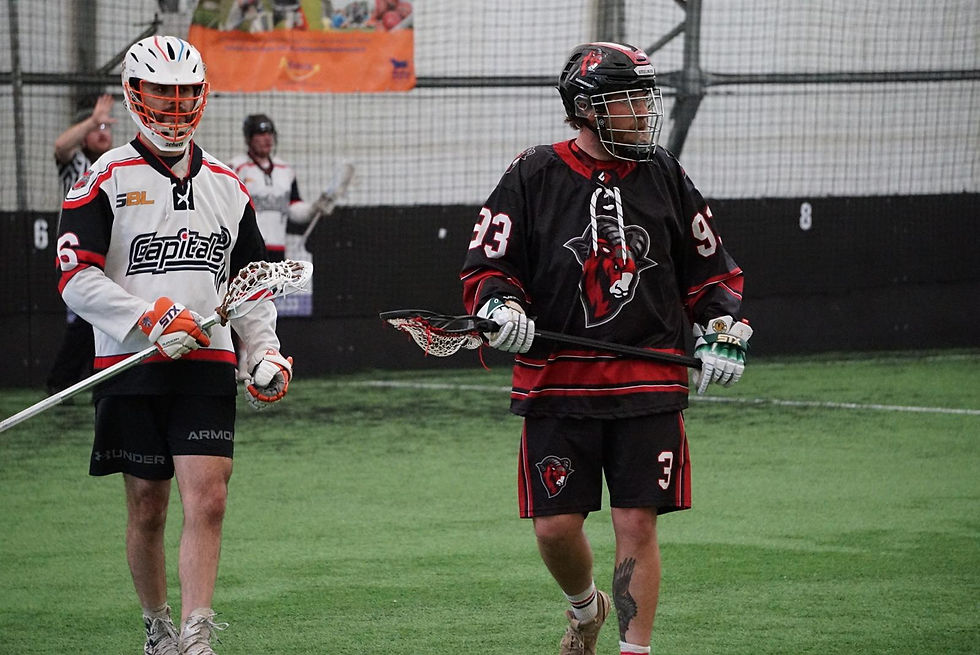
Rob has watched that impact ripple through the UK game. Since beginning to coach box in England in 2021, he has seen steady improvement not just at the top, but throughout the player base. “The box that is being played keeps improving every year. The depth of understanding across those who play — not just national team players — is getting better and better.” Crucially, Rob can see that those lessons are impacting the field game. “I can see those box concepts and skills taken to the field,” Rob adds, “and those players are tearing it up.”
Participation figures reflect that momentum. Last season, nearly 200 players competed across the men’s and women’s divisions, while England box trials attracted record numbers. For Rob, this signals a cultural shift. Box lacrosse is no longer viewed as a novelty or a late-career option, but as a legitimate pathway for development at any stage of a player’s career.
What could be the future of Box Lacrosse?
Looking ahead, Rob suggests two ways that Box lacrosse can grow.
Firstly, is the facilities. With box activity in the South largely centred around Oxford, the time commitment required to participate remains high. “The initial time investment of getting out there is significant,” he notes. A dedicated indoor facility inside the M25, he believes, would be transformative. “Something inside the M25 would make a massive difference,” he says, acknowledging that accessibility is as important as ambition.
Secondly, is having a clearer seasonal identity for box lacrosse in the UK. Rob points to sports like field hockey, where winter indoor breaks are already embedded, and suggests a similar approach could benefit lacrosse. “Nobody is thrilled to play field lacrosse on a sodden pitch in December or January.”
A game that shapes its coaches - Rob's story and philosophy.
Inevitably, coaches and players are influenced by those around them and Rob is no different. Rob states he never had a coach as a player and training was captain led, crediting Alex Harper and George Breese of doing a fantastic job at Welwyn. Henning Shmidt gave him a chance to work with the Luxembourg team in the 2018 world championships in Netanya. This chance specifically gave him the chance to work with Khris Scott, Andy Barber and Drew Pollock who taught Rob “a lot both on and off the field”.
When asked about the most significant influences on his coaching, Rob points to Andy Downing and Walt Christianson, crediting their work together with the England Box programme as being formative to his coaching.
Rob’s states that his coaching philosophy blends player-centred and transformational methods, “trust and integrity are vital, it’s a good idea to have your plays fit the players rather than the other way around.” At the same time, he is clear that comfort does not equal progress. “You’re trying to upskill players, so challenges are a good thing to implement too.”
In box lacrosse, those challenges arrive constantly. The smaller playing area, physical pressure, and shot clock compress time and space, forcing players to think and act quickly. Rob relates this to his coaching style, “Almost everything is transition, even if you’re 6v6 in field and beat a player, you’re suddenly in a 6v5 odd-player situation.” His training sessions are designed to reflect that reality. Rob favours games-based practices that mirror the demands of live play, frequently using “Gennys” (continuous 3v2s) to ensure players operate on both sides of the ball. “Everyone’s playing offence and defence and it’s a game, games-based practices are enjoyed more, and players get a lot out of it when you add specific conditions.”

Why it matters
For Rob, the motivation to return each winter is rooted in as much in people as it is progress. The Steelheads were formed as part of an early attempt to develop box lacrosse pathways, and while that project has evolved, the legacy remains. He is quick to credit the organisation behind the Winter League - particularly Rob Gooch for his fantastic work in creating a competition that continues to grow in quality and credibility. “It’s a really well-run tournament, every box player owes serious gratitude, whether they know it or not.”
Ultimately, though, it is the players who sustain his commitment. Curious, motivated, and eager to improve, they embody what box lacrosse offers the UK game. His advice to anyone considering stepping into the environment — player or coach — is simple and emphatic:
You don’t get what you don’t ask for. Put yourself out there. And play box.
Transcript
Team Performance and Strategy
After the first two game days of this season, the Steelheads sit at 1–1 – coming off a narrow 5–6 loss to the reigning champion Hornets in the opener and then a 9–5 win over the Capitals. How would you evaluate your team’s performance so far, and what factors have contributed to those results?
We have a lot of depth on our squad, and it’s important to have continuity year-on-year to try and develop a firm culture. I said to the players ahead of the Hornets game that it would go one of three ways – either they run us out of town, we win by one, or they win by one. I would only be disappointed if they ran us out of town. We didn’t secure the win, but that game gave us a firm foundation to build on.
Follow-up: What adjustments or messages after the opening one-goal defeat helped fuel the turnaround in the next game?
We had a team call after we’d gotten the first game under our belts and really tightened up on a couple of points that deepened understanding for the players.
Standout Players and Team Dynamics
Several players have stood out for the Steelheads early on – for instance, Russell Farrer’s hat-trick powered the win over Capitals, and Finn Ward notched three goals in the tight opener against Hornets. Who are some of the key performers or emerging leaders on this year’s roster, and how have their contributions impacted the team?
Our captains so far have been George Bascom, Ben Buchanan and Juliusz Bokiej, all of whom bring a stack of experience to the role. They each have had to graft to get where they are at internationally, so I think they can relate to a lot of the players who are newer to box. Finn’s a hero and no stranger to hattricks, putting three power five on the Japanese team at E-Box last year, while Russ keeps finding ways to get to the net. Charlie Albuery is a class goalkeeper and vital to that Hornets result and we were fortunate to be lent Jussi Grut (someone who I’ve worked with before with considerable ice hockey experience) for the Capitals game in Charlie’s absence.
Follow-up: Are there any unsung heroes on the squad – players who might not grab headlines but play crucial roles in the Steelheads’ success through their effort, defense, or leadership behind the scenes?
There are new guys doing a great job out there – for instance, Mike Barrett found the back of the net twice against the Capitals – and across the board everyone is doing their part. I don’t think this is a team where one guy is going to just keep going to goal and scoring; every game will be a real team game, with guys coming up the floor and scoring in transition or on breakaways. We’ve got some great experience too, with Pete Shepherd and Iain Murray who bring some additional grit to the side as well as peer-to-peer coaching. I’m also fortunate to have Matt Tatton on board helping to coach, who spent a summer playing in Canada and is one of England’s very best defenders. It really is the case though that every single player plays a role for a solid and cohesive team.
Unlike a traditional league, the Winter Box League runs on a draft structure featuring a mix of veteran talent (including national team players) and up-and-coming young players. How do you go about building chemistry and a cohesive game plan with a group that doesn’t train together year-round?
We can only protect a certain number of players each year, but in the draft, where I can, I try to get some guys who’ve played for the Steelies before, which I think helps us to mesh quickly. To be honest, I think most of the coaches do that in place of being able to train together regularly.
Follow-up: What are some challenges of coaching in a short winter league format, and how do you keep the team gelled and motivated throughout the season despite the limited time together?
It’s a short season, so there isn’t a lot of time to get things in place. I try to be transparent and coach with integrity – this is core to my coaching philosophy. If a guy’s getting cut, he gets a phone call. It’s little things like that which develop trust, and in my experience, it goes a long way.
Coaching Journey and Philosophy
You’re not only leading the Steelheads but have also been involved in lacrosse at various levels, including serving as an England Men’s Box Lacrosse Assistant Coach. What first inspired you to get into coaching, and what have been a few of the most formative experiences in your coaching journey so far?
I’d just left the University of East Anglia and my dreams of being a rock star didn’t seem particularly attainable, so I continued playing lacrosse at Welwyn Warriors. An opportunity to coach the juniors came up and it quickly grew into a broad community program. I was also coaching the University of Hertfordshire which was a great experience: I got to work out who I was as a coach, on top of the lads working hard to climb up the leagues. I’ve been coaching professionally, domestically and internationally, ever since.
Follow-up: Did you have any mentors or role models early on that shaped how you approach coaching and leadership?
I never had a proper coach as a player – a lot of it was captain-led. Alex Harper and George Breese did a great job of this at Welwyn. I owe Henning Shmidt a huge debt for asking me to come on board with Luxembourg in 2018 for the world championships in Netanya, where I worked with Khris Scott, Andy Barber and Drew Pollock who taught me a lot both on and off the field. I think Andy Downing and Walt Christianson have had the biggest effect on my coaching through working together with England Box, and have been wonderful to work with.
In terms of coaching style, how would you describe your overall philosophy? Particularly in a fast-paced, physical environment like box lacrosse, what core principles do you emphasize with your team?
A combination of player-centred and transformational coaching philosophies come into who I am as a coach. Trust and integrity are vital, and it’s a good idea to have your plays fit the players rather than the other way around. That being said, you’re trying to upskill players, so challenges are a good thing to implement too.
Follow-up: How do you instil those principles day to day? For example, do you focus on certain drills, communication habits, or cultural values to keep the team disciplined yet creative under pressure?
Almost everything is transition – even if you’re 6v6 in field and beat a player – you’re then in a 6v5 odd player situation, so good vision and decision-making is key. I use Gennys a lot – everyone playing offence and defence and it’s a game. Games-based practices are enjoyed more by the players and they get a lot out of it with specific conditions to improve particular aspects of a group’s game.
Box Lacrosse vs. Field Lacrosse and Sixes
You’ve experienced different lacrosse formats – traditional field lacrosse, the new fast-paced Sixes, and of course box. From your perspective, what are the biggest differences in coaching box lacrosse versus coaching field or Sixes? For instance, how do factors like strategy, required skills, and team dynamics adjust when moving from the large outdoor field to the tight confines of the indoor box (or to a 6v6 Sixes game)?
I try to coach them pretty similarly. Women’s field, box and sixes are all much closer together tactically than men’s field (those poles tend to change things up a bit). I think the big difference is shot clock games and non-shot clock games. In club lacrosse, there isn’t one, so you’ve got a lot of time to play with, though teams often rush things. 6s and Box both have a 30s clock, so strategically there are differences, and there are moves you can put in, like 2 for 1s where the clock is under 60s in the last play of a quarter to try to get the last shot and get an advantage.
Follow-up: Do you encourage players to play all three formats, and have you found that excelling in one format (say, box) can help a player improve in the others?
It won’t be revolutionary to hear this for some, but you get better at everything else by playing box. Playing everything else won’t make you better at box. Small goal – big goalie is way harder to score in, and you’ve got a time limit. The comparison is futsal in Brazil – there are a lot of technically gifted soccer players from that country because they don’t play big-field very often and are required to be technically sound to beat defenders and get to the net.
Growth of Box Lacrosse in the UK
SEMLA’s Winter Box League is now five years old, and each year it seems to grow – last season almost 200 players competed across the men’s and women’s divisions, the most yet. How have you seen the league and the overall box lacrosse scene in the UK evolve since its inception?
I started coaching box in England in 2021 with the South team and with England from January 2022, but had played any box available to me from when SBL started up in the late 2010s. It’s brilliant to see how much it has developed. The box that is being played keeps improving every year, whilst the depth of understanding across those who play, not just national team players, is getting better and better. I can also see those box concepts and skills taken to the field and those players are tearing it up. The word is getting out there that it’s not just something to try when you’re about to retire from field – it will help your field game from any age.
Follow-up: In what ways has the level of play or the community interest changed from the early days of the league to now?
More people are hearing about it and giving it a go. Last year Torz Ratcliffe (nee Anderson) played and was the top scorer on the women’s side, as well as Emma Savage and Minty Loxton – all three are key GB players and they were (unsurprisingly) very good! Both the men’s and women’s trials for England saw record numbers of signups, so you can only really say things are on the up.
What do you envision for the future of box lacrosse in the UK? Where would you like to see this league – and the sport in general – in another five or ten years?
A southern club-based league, with a longer winter break – nobody is thrilled to play field lacrosse on a sodden pitch in Dec/Jan. Look at field hockey – they have a two-month break when they go indoors. I think we’ll struggle to have specific parts of the year ring-fenced for field/6s/box more than that, but you never know…
Follow-up: Are there specific developments (e.g. more youth programs, dedicated indoor arenas, or even a professional box league) that you think would help take box lacrosse to the next level in this country?
The number one impediment to much more development is facilities. Something inside the M25 would make a massive difference (sorry to the South-West… though maybe you could build one too?) as at the moment the initial time investment of getting out to Oxford to play is high.
Personal Reflections
On a personal note, what do you find most rewarding about coaching the Steelheads? What keeps you passionate about coming back each season and dedicating your time to this team and sport?
It’s a team that I founded, initially to try and develop some box lacrosse for Wales. Though unsuccessful at the time, they are now looking at going to the Euros this summer, so hopefully the concept made a difference. I keep coming back to coach, because at the moment, Winter League is the only opportunity for serious box in the South. That isn’t the only reason though – it’s a really well-run tournament. Rob Gooch runs the show, and every box player owes him serious gratitude, whether they know it or not. Between booking the turf, organising coaches, the draft, first aid, filming, bench helpers, officials… I’m sure there are hundreds of other things that go into it too. When you have a great event to be at, with players eager to learn and get better, it really feel like too much trouble to come coach.
Follow-up: If you could give one piece of advice to a young or aspiring lacrosse coach (or player) based on your experience, what would it be?
You don’t get what you don’t ask for, so put yourself out there. And play box.


Been looking for a crossword generator that doesn't watermark the PDF. This one just works — AI clues saved me an hour of brainstorming.